

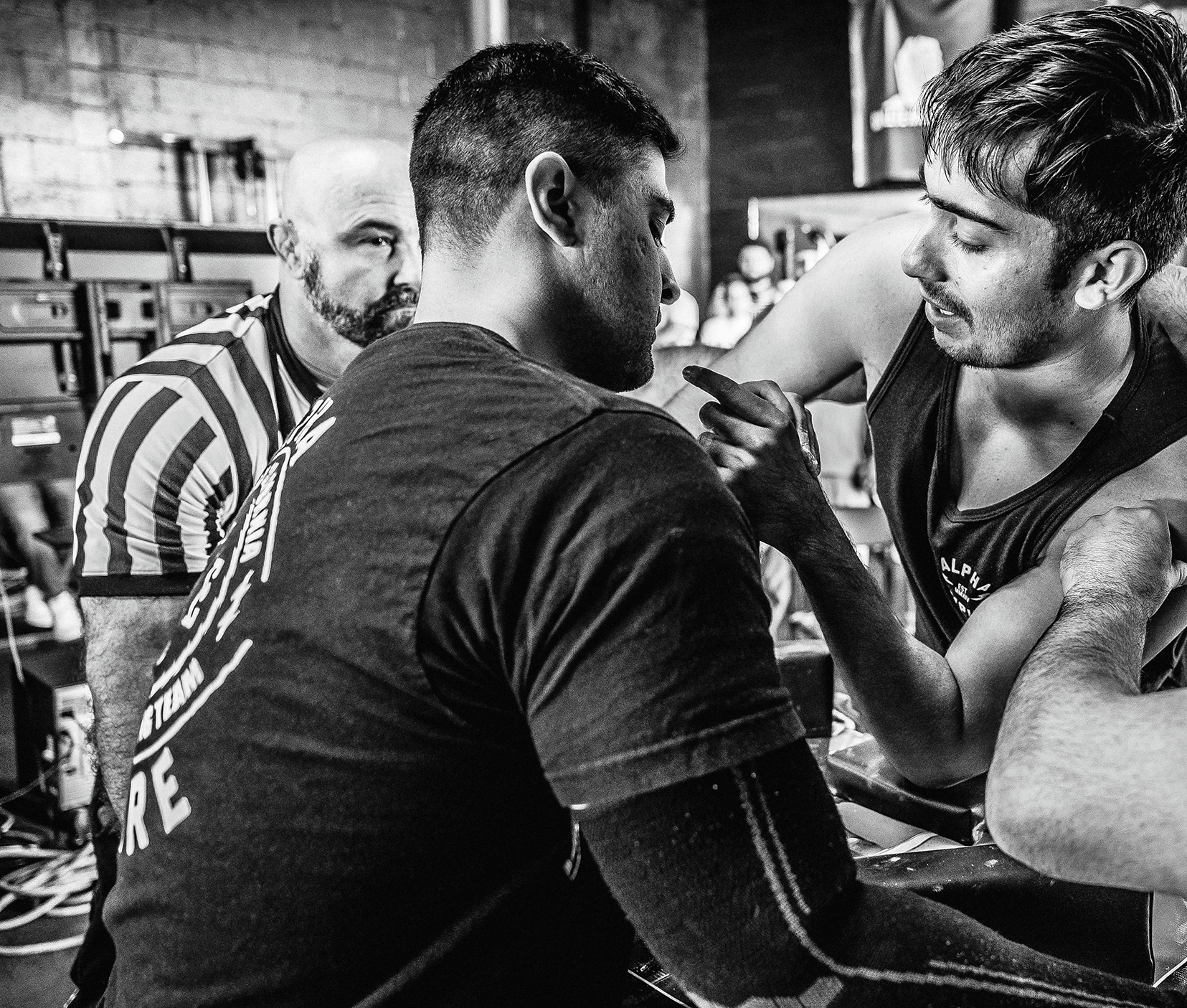
How do I become a stronger armwrestler?
This question can, and should, be asked at any stage of an armwrestler’s journey, and, to a large extent, the quality of the answer informs the quality of one’s training and efforts.
Armwrestlers are notorious for giving a wide range of answers to this question and while there is, seemingly, a diversity of opinion and ideas, we can extract some common threads that run through the various responses and start to flesh out a complete picture of how to approach our training on and off the table.
Strength Categories of Armwrestling
So what are these common threads? Well, since armwrestling is largely a strength sport (with combat elements), any discussion of how to get stronger should start with an understanding of what our body is actually doing to produce strength on the table. More generally, any effective strength-training program is going to encompass an understanding of the exact strengths involved within the range of applicable movements of a sport. When it comes to the sport of armwrestling, all of the various hand, wrist, forearm, arm strengths etc. can be broadly classified within the following two categories:
- Dynamic Strength
- Static Strength
Electronic learning or e-learning is computer-enhanced learning. A specific and always more diffused e-learning is mobile learning (m-learning), which uses different mobile telecommunication equipment, such as cellular phones.
 Photo by Priscilla Du Preez on Unsplash
When a learner interacts with the e-learning environment, it’s called augmented learning. By adapting to the needs of individuals, the context-driven instruction can be dynamically tailored to the learner’s natural environment. Augmented digital content may include text, images, video, audio (music and voice). By personalizing instruction, augmented learning has been shown to improve learning performance for a lifetime. See also minimally invasive.
Rote learning is memorizing information so that it can be recalled by the learner exactly the way it was read or heard. The major technique used for rote learning is learning by repetition, based on the idea that a learner can recall the material exactly (but not its meaning) if the information is repeatedly processed. Rote learning is used in diverse areas, from mathematics to music to religion. Although it has been criticized by some educators, rote learning is a necessary precursor to meaningful learning.


Nonformal learning is organized learning outside the formal learning system. For example, learning by coming together with people with similar interests and exchanging viewpoints, in clubs or in (international) youth organizations, workshops.
Informal learning is less structured than “nonformal” one. It may occur through the experience of day-to-day situations (for example, one would learn to look ahead while walking because of the danger inherent in not paying attention to where one is going). It is learning from life, during a meal at the table with parents, play, exploring, etc.
Sing like no one’s listening, love like you’ve never been hurt, dance like nobody’s watching, and live like it’s heaven on earth.
The educational system may use a combination of formal, informal, and nonformal learning methods. The UN and EU recognize these different forms of learning (cf. links below). In some schools, students can get points that count in the formal-learning systems if they get work done in informal-learning circuits. They may be given time to assist international youth workshops and training courses, on the condition they prepare, contribute, share, and can prove this offered valuable new insight, helped to acquire new skills, a place to experience.
Internal factors
Play, as it pertains to humans as a form of learning is central to a child’s learning and development. Through play, children learn social skills such as sharing and collaboration. Children develop emotional skills such as learning to deal with the emotion of anger, through play activities. As a form of learning, play also facilitates the development of thinking and language skills in children.
Transfer of learning is the application of skill, knowledge or understanding to resolve a novel problem or situation that happens when certain conditions are fulfilled. Research indicates that learning transfer is infrequent; most common when “… cued, primed, and guided…” and has sought to clarify what it is, and how it might be promoted through.
In incidental teaching learning is not planned by the instructor or the student, it occurs as a byproduct of another activity — an experience, observation, self-reflection, interaction, unique event, or common routine task. This learning happens in addition to or apart from the instructor’s plans and the student’s expectations. An example of incidental teaching.